

Chemical Engineering Partners
Re-refining vs Recycling
Compare the resource and energy implications.

In the lube oil industry, the term “recycling” is very different from “re-refining.” To help you understand the difference, here are the definitions:Recycling of used oil:
The term “recycling” used oil generally means to take used motor oil and use it for a different purpose, most commonly to be burnt as fuel. In the lube oil industry, “recycling oil” or “reconditioning oil” most commonly refers to using commercial filtration systems to remove insoluble impurities. This method, however, does not remove any of the soluble contaminants. The resulting oil has very limited uses. In some cases, reconditioned oil is mixed with additives in order to prolong its life. Recycled oil is generally used for fuel and is only good for one-time use. Reconditioned oil is not suitable for use in automobiles. Recycling or reconditioning used oil represents the lowest tier of handling waste in the circular economy.
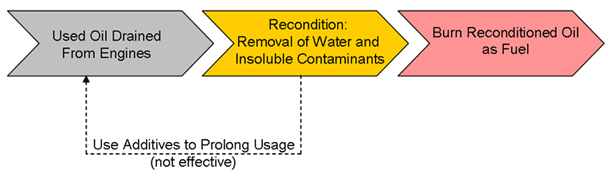 Re-refining of used oil:
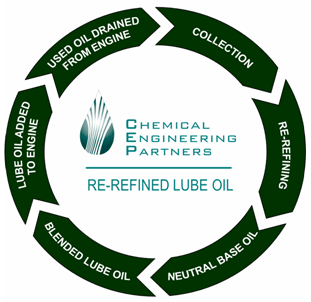
 Re-refining is a process that starts with vacuum distillation and then polishes the oil with hydrotreating. It removes all impurities, both soluble and insoluble, and returns the oil to a quality that is equal to or better than some virgin base oils. In fact, the base oil product can meet API Group II specifications and is suitable for automobiles. Re-refining used oil is less severe than the refining of crude oil and uses less energy. Motor oils can be re-refined many times. Re-refining exemplifies the highest tier of the circular economy by taking a valuable resource and returning it to its original use, which is why the US EPA has identified re-refining as the “preferred option” for managing used oil since 1996. The diagram below demonstrates the process flow for re-refining.
Discuss your project with CEP.
For feedstock-specific requirements, project scope and current commercial details, contact CEP’s team.
Your next re-refining project